Showing posts with label Starting BJJ. Show all posts

Saturday, January 16, 2016

Are you injured or are you hurt??? Should I train when I am hurt?

Hello everyone! I am back from my Holliday break in blogging. I have two guest blogs coming up. My two guest bloggers are being slow and lazy, so I thought I would throw together something on my Saturday night.

It goes without saying that you will have boo-boos, ouchies, nicks and bruises when training BJJ. At it's essence, BJJ is all about trying to make your opponent quit through threat of injury, or actual injury. However, there is a big difference between being hurt and being injured. Hopefully, this blog might help you better decide if you should "suck-it up buttercup" or take a little time off.
My broken pinky toe, because I want you to feel sorry for me. 
Before I get into the meat of this blog I should make a disclaimer: I am a doctor, with that being said, I am not the type of doctor that actually helps people (I have a PhD in Child Development). So, any advice I give is purely earned from experience and not a medical diagnosis.

I have been very fortunate in my grappling career. I can think of two instances that have forced me to miss time on the mat. Our coach separated my shoulder on a throw and I got my knee popped on a cheap heel-hook, other than that, I have been able to train without major injury. But, it seems like I always have a sore part or two. We have a great club that tends to be incredibly safe and friendly. If you are at a gym where guys are getting seriously injured on a regular basis, you are at the wrong gym. Find somewhere else that values your health. Nothing trumps mat time. It is far better to roll at a lesser known gym a lot, than a premier gym where you are missing time because higher belts are ripping your arms off for trophies.

Good example of why to tap. 

So, what type of injury should you not roll with? Any broken bone, anything you cannot put weight on, anything that if it is more seriously injury you will not be able to do your job. We have several construction workers who come to our class, if they broke their leg, blew out their knee, etc. they would be off the mat for awhile and losing money they use to feed their family. DON'T MAKE YOUR FAMILY GO HUNGRY. You can always come back to the mats when you are healed, but if your bone is broken or a joint is seriously injured, it will eventually force you off the mat. You might as well heal it now and get on the mat sooner, than tough it out and roll like poo for 2 weeks and still have to rehab the injury. Here is a great article about common BJJ injuries.

The more tricky situation is when you are hurt and not sure if you should roll. I would suggest you start to build a stable of partners you can roll "light" with, to test the injury. Typically, an upper belt is going to be good for this job. They have better control over their body and will not maul an already injured appendage. Also, they get subs all the time, tapping out a white belt is not going to be a notch in their belt. If you can roll light with little or no pain, then you should increase the intensity when you feel comfortable.
 

In the event a you are not able to finish a light roll without getting getting hurt, you should take it easy. I would suggest coming to class and still doing technique. When you are unable to do technique without pain, try to roll light again.  After you can roll light with minimal pain, start to increase the intensity.


Respectable instructors and fellow BJJers will not frown on you for getting yourself healthy after an injury. The only time classmates and instructors will start to question your injury status is when you are taking to long to tap (typically this problem takes care of itself) or you are using a former injury as an excuse to get out of rolling. I am not sure why anyone would want to get out of rolling, that is the best part.

Monday, November 16, 2015

Shut up and take my money!....A comment on buying equipment.

So, you have made the decision to start BJJ. You have researched schools, read about the Gracie lineage, and even practiced leg locks on your dog. You are driving to your first night and then you have a moment of panic....what should you wear? Should you stop at the local TKD club and get a dobok?


Maybe this is a gym that wears wrestling singlets???

Ohhh my.....
Have no fear, I can honestly say your best bet is to go to your first class and talk to the instructor. Every gym is a little different. At our gym, we are happy to let people try class for a few weeks and then make a commitment to buy a gi. Other gyms don't use gis. Some gyms will have you buy one the first night. The main thing is not to panic.

With that being said, if the gym you go to uses a gi (and in my opinion training in the gi is really important) you will want to buy a decent one to start out. That is not to say you need to plunk down $350 on a used Shoyoroll, but you should get one that fits well.


A couple reasons:

  1. A nicer gi (roughly between $90-$175) is going to fit well. It seems odd in a rough and tumble sport that fit is important. However, I have owned a good number of gis and I have had several that fit weird. They quickly were at the bottom of my rotation and the money I spent on them was wasted. Honestly, if you stick with BJJ you will end up with 2-5 gis at anytime. If you have one that just doesn't fit right, you won't wear it. 
  2. That money spent is going to force you to commit to coming. I don't like to spend money on useless items. When I plunk down what amounts to 15 - Six Pack and a Pounds, I am going to make sure I use that item. 
  3. A new gi makes you feel badass! You are going to wear it around your house when you get it. That is fine, take some pictures, trash talk the mirror, try to choke your significant other out with the lapel, live your life. 
The main thing to remember, you need to ask your instructor what they prefer. Our gym is pretty loose with the type of stuff you can wear. Some gyms only want white or blue gis. Don't plunk down what amounts to 30 - KFC $5 Fill-ups and then have to sell it. If your gym has no rules, talk to your gym-mates, try on their gis. You are going to find they are really excited to share their knowledge. Currently, I roll in a 2 Fuji gis and a 12NV gi. They range in price between $120-$150. I previously owned a $200 Atama and really couldn't tell the difference between it and my cheeper gis.  

As far as other equipment you might want to invest in (probably over your first 6-12 months):
  • A mouth piece. I chipped my tooth in June of this year. Like all issues, I just assumed it would resolve itself. It sure didn't, I further chipped it 3 months later. My dentist was impressed with how bad I chipped it! She did not give me a reward for my insolence. She did give me a $400  bill (that is 40 - Drunken Noodles at Ginger Thai). Protect those pearly whites. Most $5-$10 mouth guards will do. 
  • A pair of grappling shorts. You can get by with basketball shorts or athletic shorts for awhile. But, eventually they will get annoying. They will slip off, they don't stretch as well. There are tons of different types of grappling shorts on the market. In my experience, grappling shorts below $20ish dollars are crap. Anything above will do just fine. A $60 pair of shorts is not 2x better than a $30 pair. I just got a pair of Jaco shorts from BJJHQ.com . It has some great rolling deals, if you are in to that type of thing.
Checkout my new Jaco shorts.
  • Compression shorts, nut-cup, bra with reinforced cups. Mix and match for your primary and secondary sexual trait needs.
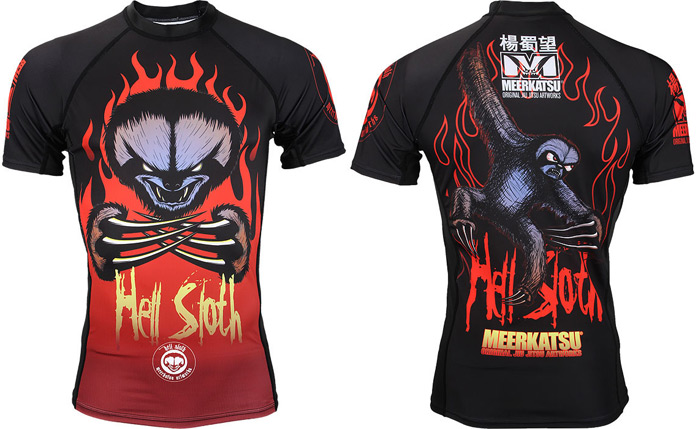
  • A rash guard/compression shirt. This is one of those things you don't have to drop a lot of money on. I rolled in a $5.99 Champion compression shirt for my first 5-6 years and thought it was great. I upgraded to a $30 compression shirt from Meerkatsu and really like it. You can get rash guards for $60 (if they are blessed by Marcelo Garcia....I hear you will get the power of flight). The upside of a more expensive rash guard are the cool graphics and the quality of the shirt. There are some really neat looking rash guards on the market. The other big advantage of a more expensive rash guard is the quality of the material. It is thicker and holds shape longer. Finally, you will find both long sleeve and short sleeve. I like to rub my arm hair in peoples' faces, so I go short. 
This is my current rash guard
That is about it. You really can get by spending $200-$250 dollars over the course of your first year. You can also drop well over a grand if you have that money. However, the more you compete and the more serious you get, the nicer equipment you will probably want. Also, the more you train, the more equipment you will need...because you will wash your gi. Believe me, the last thing you want to be is the smelly kid. 


Wednesday, November 11, 2015

F@**@*#*@($(*(#CK…A comment on dealing with frustration

It happens to all of us, we think we are making progress. We have made it to tons of classes, we are practicing moves and then you go up against your “white whale.”


A quick diversion from the initial story, a person’s “White Whale” is a term stolen from Moby Dick. In the book, Captain Ahab is obsessed with catching Moby Dick (a white whale) that took his leg below the knee. See it is apt for the post because a person’s white whale is someone they really want to submit.

Back to the main point, we all have the one person in class who subs us, over and over again. Humility is important in Jiu-Jitsu, but so is a desire to get better. It is Ok to want to submit guys who are better than you, it shows you care about your progression. So, you go up against your “white whale” and POW! 

They submit you. You shake it off and then POW!!! Same move! It happens again and again. You can feel that heat rise up in your cheeks, you start talking to yourself, you are getting really frustrated.


I will be the first to admit, this happens to me. Recently, I have been getting caught in knee bars…all the damn time. It bothers me, the other day I punched a wall after getting caught twice in a roll by the same knee bar. 

Dumb idea, the wall didn’t knee bar me and it didn’t really get hurt when I punched it. I ruminated on the fact I got subbed by the same move on the way home. I Googled, “ways to stop knee bars”, “how to not get caught in knee bars”, “why do communists only use knee bars?”, “Why are Sambo kurtkas red? Is it because they are communists who use knee bars?” Needless to say, I am invested in solving this knee bar problem. Which I think is one of the few times where frustration can really benefit a person in BJJ.

In my experience, there are two types of people who get frustrated in BJJ. There are the people that quit when they reach a level of frustration and people who persevere. The former are not able to handle the fact that they don’t get a move or keep getting beat by a move or the same person beats them over and over. They look for immediate rewards, which come often when you start BJJ. As a person moves along in BJJ, those gains become less frequent. The extrinsic motivation fades and they end up quitting.

Could be worse! Am I right?!?!?

However, the other type of person looks at the issue causing frustration as a problem to solve. They take agency of their problem and look for solutions. Eventually, they will solve that problem and their motivation is reward with a new challenge. In this way, frustration is great, it motivates BJJ practitioners to get better.

If I were to give advice to myself starting out 6 years ago, I would say to try to solve problems for myself early on. This ability to take agency for my own development will serve be a huge advantage when I am one of the top 4 or 5 people at my gym or when I am coaching. At this point, there may be no one at the gym that can answer my question about stopping the inverted guard, I will have to figure it out on my own.  As long as I look at it like a puzzle I can solve, the frustration will only motivate me.


P.S. Still working on stopping that knee bar, thanks Doodles