Showing posts with label BJJ humility. Show all posts

Thursday, January 21, 2016

Bro, it doesn't matter that he outweighs you by 70 pounds, you do BJJ...

I understand where the romantic notion comes from. The one where people think anyone who does a martial art can beat people twice their size in mortal combat. I grew up watching Kung Fu movies where a tiny master took out six guys with one hand and then made a witty comment (your Master should have taught you respect).


 I was in awe when Royce Gracie beat Dan Severn when I watched the fourth UFC in 3rd grade.
Royce beating dudes...

When I heard BJ Penn fought at heavyweight, it only further reinforced the idea that all martial artists can beat up anyone (regardless of size).

Penn vs Machida

 Let it also be known that I am not a big guy. I am about 5'8" and weigh around 160 pounds. It has been my experience in all of the sports I have played and the few fights I have gotten into, that size matters.
Picture of Jeff Curran, Marcelo Garcia and me, to help you gauge my size...and remind you I hangout with Jeff and Marcelo
I am stubborn though and held onto the belief that someday I would learn a martial art and pummel men much larger than myself. As a senior in college I took Hapkido, then Judo and Sambo when I moved to Kansas City. Finally, I ended up in Waterloo, IA and landed at a great BJJ gym. I now have around 6-7 years of BJJ experience and about 10-11 years of martial arts/grappling. What follows below are my heartfelt words on the role weight/size plays in BJJ, grappling and fisticuffs.

To start, size matters. If size didn't matter, there would be no weight classes in the UFC, BJJ tournies, etc. However, skills can certainly overcome size disadvantages. Case in point, every once in awhile we have a new, strong, young lad come into our gym. Typically, they have a lot of wrestling experience and feel like they are going to run through everyone we train with. It has become our time-honored tradition to find a smallish, white belt (the dorkier looking the better) and deem them our "gatekeeper." His or her job is dispense humble pie to all jerks who darken our door step. When it comes to an unskilled combatant against a skilled BJJ practitioner in a controlled BJJ gym, size doesn't matter that much. On a side note, I once held the gatekeeper title because there is nothing more deflating than a soft, middle aged, college professor dealing out punishment.

Check out Riley Breedlove tooling high school wrestlers in a park. 

When it comes to the effectiveness of BJJ on the streets, it is also pretty useful for people of all sizes. Luckily (and to my low-key disappointment) I have never had to use my "jitz" in a real fight. But, all you need to do is look up videos online or check the BJJ message boards. Given the option between wildly throwing haymakers and/or trying to tackle someone when I have little to no experience, I would rather have the BJJ on my side. With that being said, you never know who is getting into a fight with you. They might have trained forever, maybe they are a golden gloves boxer, maybe they are an X-Men (probably the least likely scenario).
If I was an X-Men I like to think I would be Nightcrawler 
 If you are looking to get into BJJ just to kickass at the bar, maybe you should instead just go to AA.

Watch this video, it is worth it. 

When Jiu-Jitsu meets Jiu-Jitsu is typically when size advantage plays the largest role. Yes, there are some great instances of smaller BJJ players beating bigger opponents (Marcelo vs Ricco Rodriguez or Makenzie Dern vs Gabi), but most of the time a bigger competitor wins the absolutes at a large international tourney.
Marcelo vs Ricco

Mackenzie Dern vs Gabi 

2013 road to ADCC absolute for Cyborg

In my personal experience, skill greatly compensates for a size advantage. We have several newer blue belts who are much bigger than me and I can hold my own. However, we have a brown belt who is close to my size and he absolutely railroads me. There is a purple belt at another school who I am 25ish pounds heavier than and I can typically control him because of my extra fluff (that is what I call my "Dad-bod" parts).


In an extremely simplified sense, skill can make up for weight/strength deficits and weight/strength can make up for skill deficits. I try to use this to my advantage by always saying I weight less than I do, and asking for the weight of a person who tapped me. If there is more than a 10 pound difference, I blame it on their girth and get to keep my ego.

In short, if you are looking to do BJJ because you think you will become a Super Sayian who can beat people 5 times your size, you will be disappointed. But, if you want to take BJJ to improve your confidence, feel more safe if in a dangerous situation or hopefully get a chance to tool "d-bags" that get off on pushing around little guys/girls, you are in the right sport. Just remember, the ability/right to beat people bigger than you is earned from years (and I mean years) of getting beat on that mat, it is not a training montage type of thing.

Thursday, December 3, 2015

Don’t worry about your belt rank, but seriously keep coming in to get promoted….a comment on promotions in BJJ

Welcome back from Thanksgiving ya’ll. Hopefully you stuffed yourself with food and then tried to roll, resulting in someone getting sick on the mat. It really is the only way to go.


The weekend before Thanksgiving our instructor (The Honorable Greg Halsor) promoted two of our white belts to blue. Aside from live rolling, belt promotions for other students are one of my favorite things our club does. We are a tight-knit club and we do not promote quickly. So, when someone finally achieves a higher belt, it is a pretty big deal. A belt promotion is also a success for all the higher belts. There was a lot of time and effort put into my progression (as a white belt and currently as a blue belt) and my teammates should (hopefully) feel equally responsible for any success I achieve.


With all that being said, belt promotions in BJJ are a lot different from other martial arts. First off, when a student is given their belt many school have different ceremonies to recognize the achievement. Some gyms whip students with their belts,

 Greg and Jeff Curran have always thrown us, 
The throws look basically like this....


other gyms visit a Turkish Bathhouse (I am not sure if that is true, but it sounds plausible). 


I like the idea of throwing students, it reminds students that no matter your rank, you are doing this to practice the art. I don’t get the belt whipping, it seems unnecessarily punitive (Caio Terra doesn't agree with the belt whip). Turkish Bathhouse is cool if that is your type of thing.

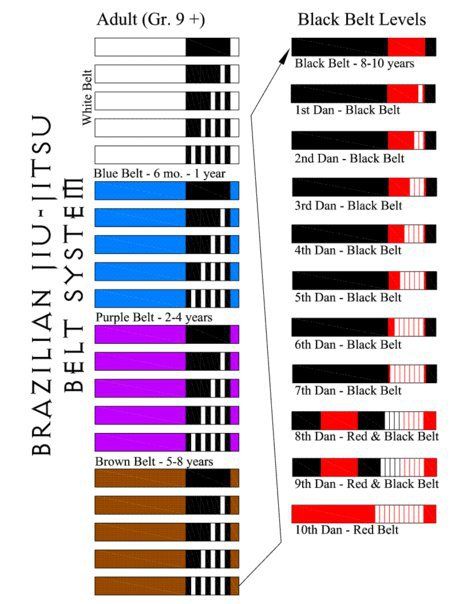
The other enigma related to belts in BJJ is how a student is actually promoted. The process is awkward to say the least. Some schools have a set testing curriculum (our organization is moving that way), other schools just promote when a student is ready, and still others have been accused of only requiring money. In addition, the length of time a practitioner has to spend at each belt varies greatly by school. The IBJJF has a set standard, 

as do several other organizations. With that being said, belt promotions are really handled from school/organization to school/organization.

However, there is one thing that every BJJ gym I have went to says to all new students, “Don’t worry about your rank, just come in and train.” There are undertones of this saying I love and their implications I do not. First, I think one of the main goals of this statement is to remind students that they are only as good as their ability to roll on the mat. Simply put, if you are a black belt and get handled by blue belts in live rolling, does that really mean you are a black belt (see this link for an extended discussion on promoting people too quick)? It is best for the new student to focus on learning and improving their ability to roll with their teammates. Great lesson, everyone should read it 10 times before they go to bed.

It also reminds students that they should trust their instructor and higher belts to be mentors to them. The higher belts and instructors will be there to give new students instruction, feedback and encouragement. With that, if they show up and participate the belt will come. BJJ really is an outstanding environment in that way. Also, it rewards hard work and dedication…more than a deep pocketbook (this link is a great article on charging for belt promotions).

On the downside, “don’t worry about the belt…but keep coming in and training and working towards the belt” is really ambiguous. As anyone who has participated in BJJ knows, it is a sprint not a marathon. 2-4 years to a blue belt (in some schools) is a crazy long time. To add to this ambiguousness, many instructors are not great at communicating with their students about their progress and the expectations for promotion (for the most part this is not our school or organization). Finally, students pay a lot of money to participate in BJJ (most of it well earned by the instructors, I understand they run a business). This all adds up to a very arduous slog towards progress. Yes, progress needs to be an internal desire on the student’s part, but desire is fostered by success and vice-versa. We had a former students who had outstanding attendance, busted his butt to get his blue belt. Finally, he tested for it, received it and then never showed up again. Some of that is on him, but I also think the process of working towards that belt burnt him out.

What is a new student to do? First off, pick a good school. An instructor that is honest and cares about BJJ and their students will solve many of these problems. Second, set intermediary goals on your way to getting a belt. Some schools “stripe” belts, which is a great bit of encouragement. But, students should also remind themselves when they achieve a success. Did they last 40 seconds against the purple belt when they typically last 20? They should buy themselves a McFlurry on the way home…unless they are lactose intolerant, then they might want to go with some McNuggets.

Can't all be this happy everyday....
What has helped me the most (remember, I am for sure not the “fore most” expert on this stuff) has been to seek feedback from upper belts. They are typically amazingly encouraging. When I started out there was a blue belt named Brian whom kicked the crap out of me all the time. However, after we would get done rolling, he always had something complimentary to say. Such as, “wow, you are getting your guard back quick when I pass it” or, “dang you didn’t feel nearly as close to a dead fish as you did before.” I remember driving home and thinking, “if someone that good notices my advancement, it must really be happening.” When I asked for feedback he happily gave it to me. When he learned a new move that suited my style and skill level, he eagerly showed it to me. This all kept me coming back. I try to emulate that quality to our new guys and it seems to keep them around.  

Tuesday, November 3, 2015

I got arm bars you ain’t never seen bro….A comment on humility in BJJ

For anyone that has ever attend a martial arts class, watched a kung fu film, or talked to someone who does martial arts, they know that humility is something that is preached.  To be sure, humility is an important part of Brazilian Jiu Jitsu as well. However, the road to humility and the vehicle through which it is taught, is a lot different than many other martial arts.

Kanye knows about humility

I have had my fair share of experiences in martial arts. I took Tae Kwon Do and Shurite as a child. As a college student I participated in Judo and Hapkido. 

Shuri...what?

In all of these disciplines respect and humility is preached. Often times a creed is recited before and after class. There are symbols for the concepts of humility and respect hung on the wall (typically in an Asian language). I think this is great, especially for kids. In our school and all the others I have trained at, there is less of an emphasis on overtly talking about the importance of respect. As a result of the structure of BJJ, there is not really a need for this verbosity.

Here are some symbols for humility...or from a take out menu. It could be either.

At it’s core, Jiu Jitsu is an art/sport where people compete against each other every class. As a result, humility and respect get infused into the culture for about 45-60 minutes at the end of class (when we try to choke or break someone's arm). If someone thinks they are the best person on the mat, they will get a chance to prove it. If they submit everyone that night, they will have to do it the next night, and the night after that. Eventually, that person will get subbed. In that moment, there is probably going to be a reckoning with the high opinion they hold of themselves. Often times, participants quickly learn that it is far easier to be happy to have the opportunity to learn and quietly celebrate when they get a submission against an upper belt or congratulate a person when they are submitted. In addition, when applying a submission to a training partner, it is always in my mind to be safe...at some point that person will catch me and I hope they return the favor.

About 4 years ago, we were getting ready to start class when a very muscular ex-service man came in. He had tribal tattoos and lifted a lot at the gym (so he was pretty certain we knew he was for realz). As we were warming up he turns to our coach and says, “I already know this stuff. I have got armbars you guys ain’t never seen. I just want to roll live.” In that moment our coach was faced with two choices, explain the importance of humility and respect. Let the student know that BJJ is a process and takes many long hours of improvement before a person gets better, etc. Or, let him role with one of his students and experience why humility and respect are a virtue. To our enjoyment, he picked option number 2!

Enter my good friend Ned (not his real name). Ned is an outstanding competitor. He is also somewhat of an enforcer for our class. This is a good thing, every class needs a Bob Probert. 

Bob who????

Our coach set the clock for six minutes, the young man made it maybe 2 minutes against Ned. Clearly, he had arm bars we had never seen. The problem was, they were really ineffective.

Essentially, the match looked like this


2 side points: 1) I am categorically against beating up on new people and teammates. That is a dick move, it ruins a club. 2) There is a lot of hyperbole around respect and humility in BJJ. There are pictures of chiseled swarthy men in gis, staring menacingly into the camera, with captions like, "Lions eat elephants which are bigger than them, so be nice.....OSSSS!!!" 

Like this. I want to believe it, it's in black and white!

I don't think we need all that. The beauty of BJJ is that it self regulates egos through challenging a person's skill. After a person gets beaten so many times, they either become humble or become an ex-BJJ participant. This wasn't a case of a new guy getting picked on, it was a person who needed a reality check of their skill level. After his beating, he faked an injury, said he would be back next class and never returned. He could have been a great guy, he could have been Charles Manson, I don't know. What I do know, he wasn't ready to participate in BJJ at that point. 

We have a lot of different personalities at our gym. We have had (at most) one or two instances where someone has had to step between two guys that were ready to fight. Honestly, a person doesn’t need to fight in class to assert their dominance in BJJ. Everyone in class knows that by the end of class that will have taken care of itself.